Oopbuy UK line weight windows and box sizes
Minimum and maximum weights, first-weight steps, billing floors and the box rules behind each UK line.
Weight windows on the UK board
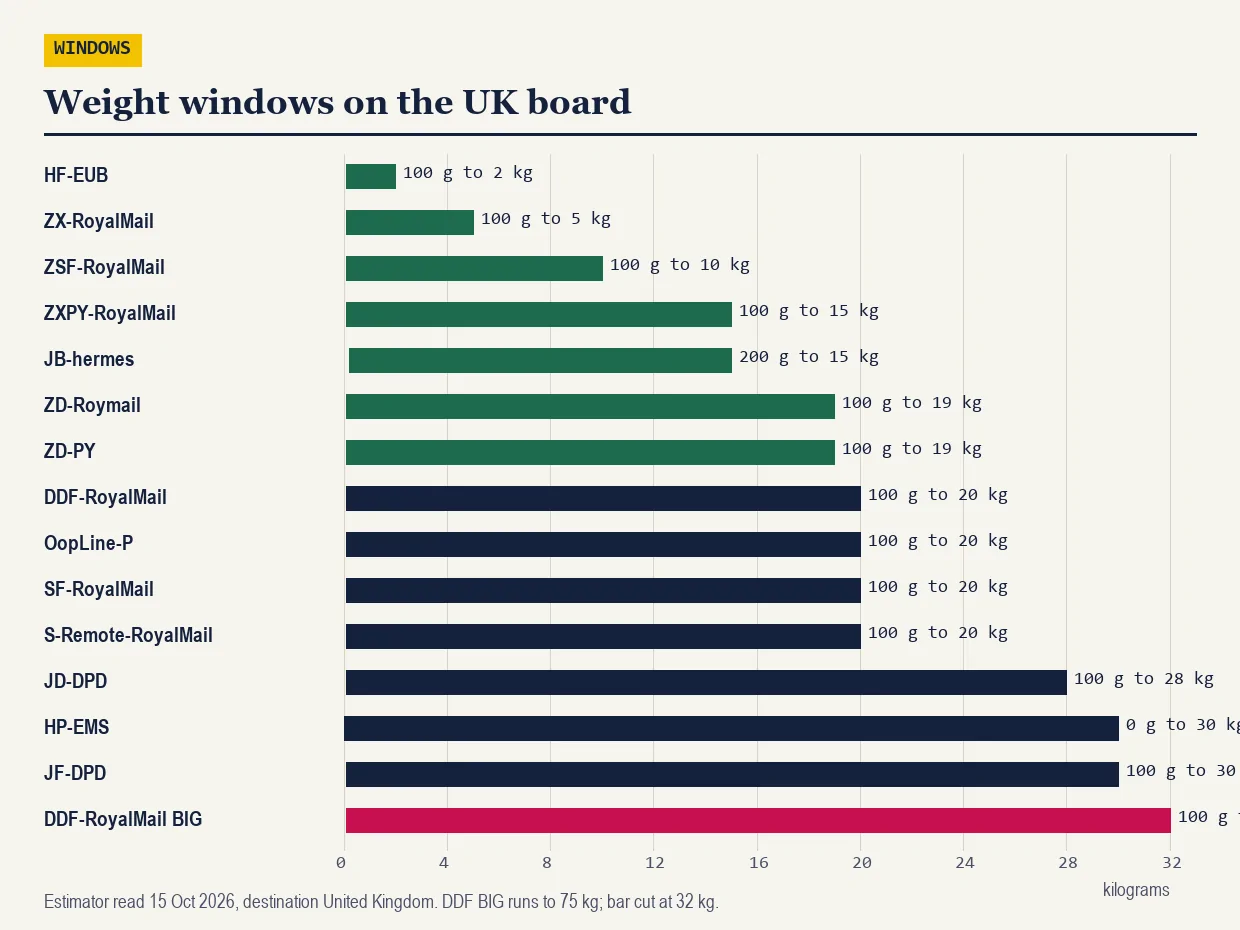
Most UK lines accept parcels from 100 g. JB-hermes starts at 200 g. At the top end the board thins quickly: HF-EUB stops at 2 kg, ZX-RoyalMail at 5 kg, ZSF at 10 kg, ZXPY and JB-hermes at 15 kg, ZD-Roymail and ZD-PY at 19 kg, and four more at 20 kg. Above that only JD-DPD (28 kg), HP-EMS and JF-DPD (30 kg) and DDF BIG (75 kg) remain.
If a parcel preview comes back heavier than you expected, the lines you were counting on may simply vanish from the list. Splitting into two parcels keeps more lines open, though Oopbuy's packaging page notes that two parcels are judged on their own merits by customs too.
First-weight steps: when lighter costs the same
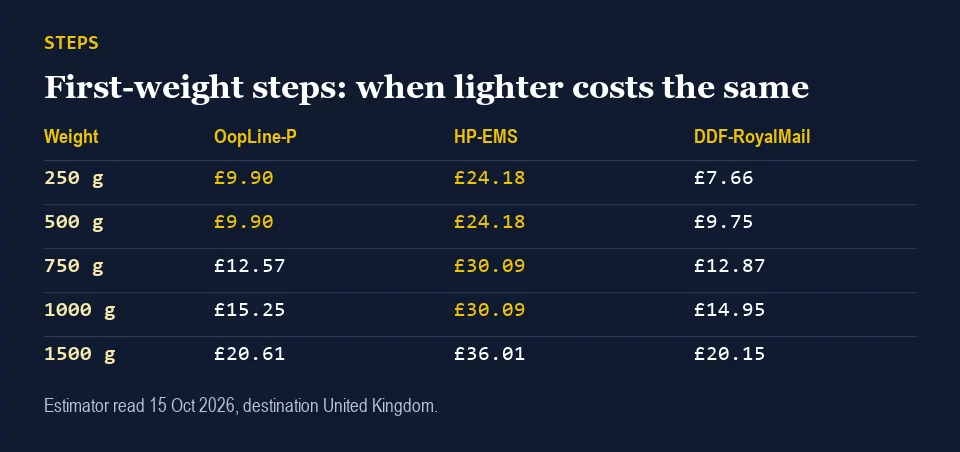
Each line bills in steps. DDF-RoyalMail rounds to 100 g, so 250 g and 750 g are priced differently (£7.66 and £12.87). OopLine-P's first step is 500 g: a 250 g parcel costs the same £9.90 as a 500 g one.
HP-EMS rounds every half kilo up: 250 g and 500 g both read £24.18, 750 g and 1 kg both read £30.09.
For a single light item, a line with a fine step usually beats one with a coarse step even if the coarse line looks cheaper at a round number.
The DPD billing floor
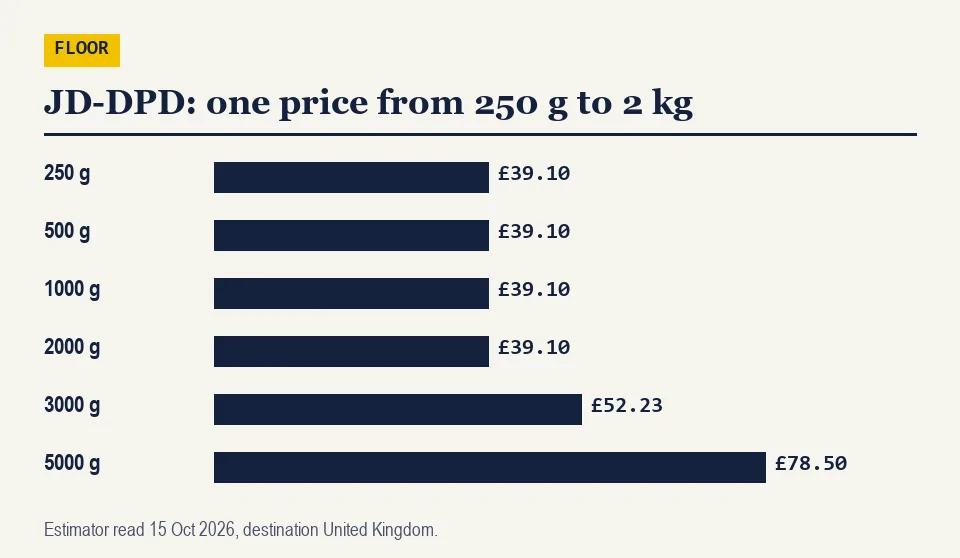
Both DPD lines say: 'The minimum billing weight is 2 kilograms. Any weight less than 2 kilograms will be charged at the rate of 2 kilograms.' JD-DPD reads £39.10 from 250 g to 2 kg, then £52.23 at 3 kg and £78.50 at 5 kg.
That makes DPD the wrong answer for one T-shirt. For a 5 kg battery parcel that needs the fast delivery profile it is a fair option: £78.50 against £65.37 on ZD-Roymail, the cheapest battery line, which sits in the middle profile.
Box size rules, line by line
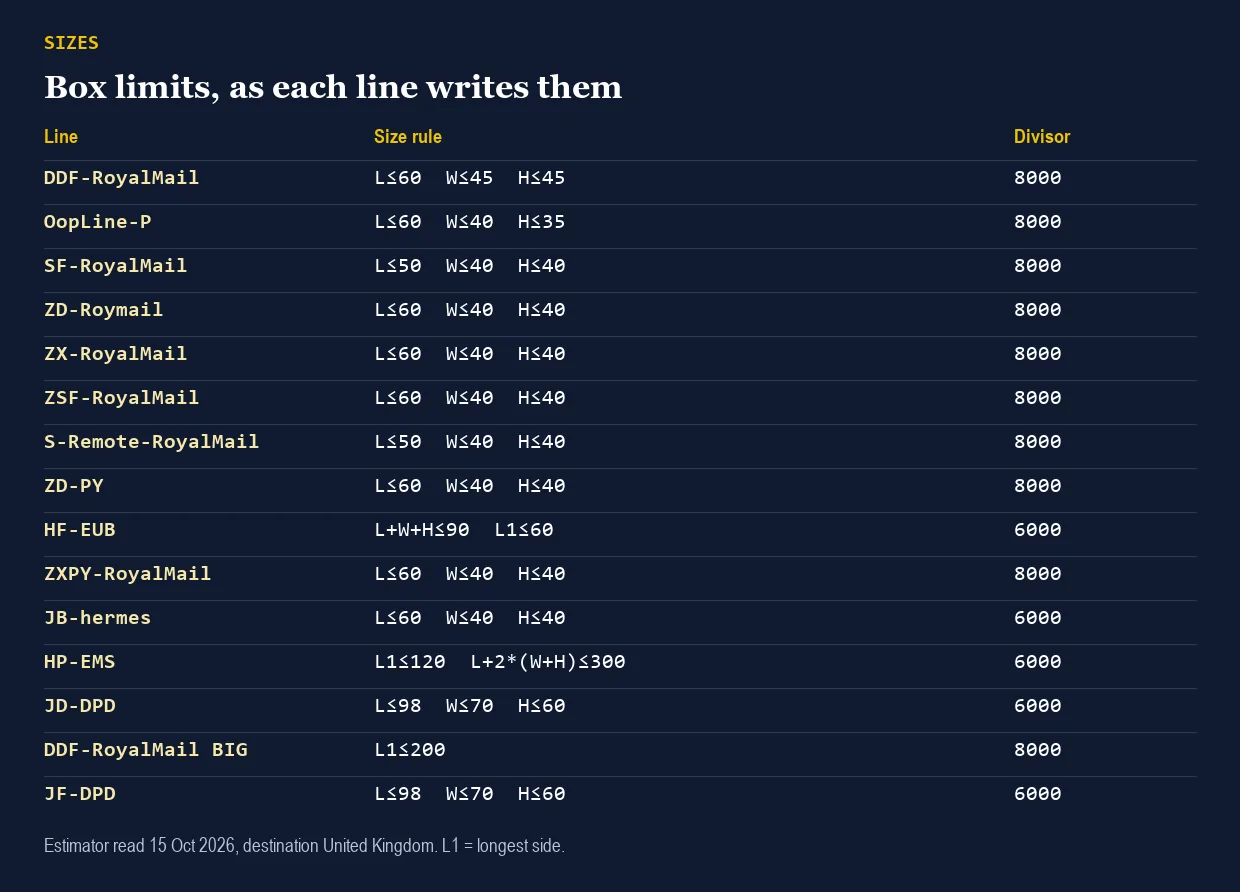
Most Royal Mail-named lines cap each side: 60 x 40 x 40 cm is common, DDF-RoyalMail allows 60 x 45 x 45, OopLine-P 60 x 40 x 35, and SF and S-Remote 50 x 40 x 40. HF-EUB caps the sum of the three sides at 90 cm with no side over 60. HP-EMS uses a girth rule: longest side up to 120 cm and length plus twice the width and height up to 300 cm. The DPD lines allow 98 x 70 x 60, and DDF BIG only limits the longest side to 200 cm.
Oopbuy's own consolidation rules add one more: any item with a side of 90 cm or more is flagged to ship on its own.
Volume weight: the divisor matters more than the line
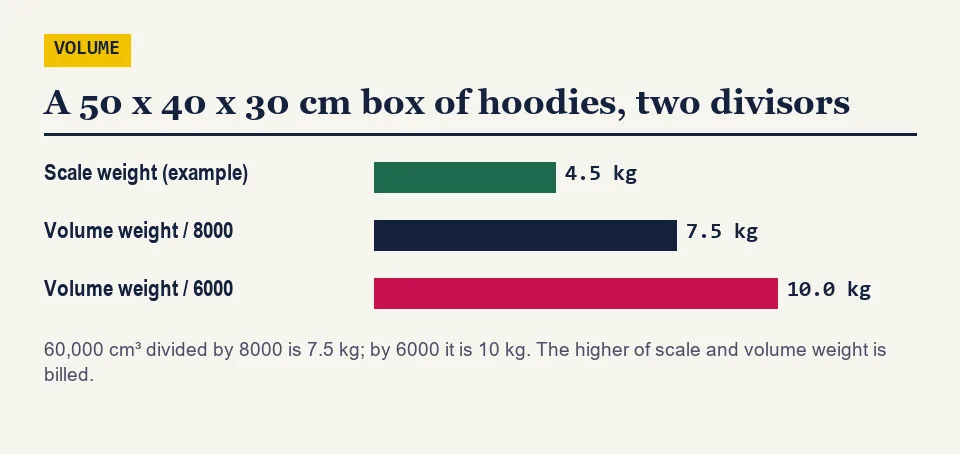
Every UK line bills the higher of scale weight and volume weight. Volume weight is length x width x height in centimetres divided by a divisor: 8000 on the Royal Mail-named lines and OopLine-P, 6000 on HF-EUB, HP-EMS, JB-hermes and both DPD lines.
A 50 x 40 x 30 cm box of hoodies is 60,000 cm³. On an 8000 line that bills as 7.5 kg; on a 6000 line, 10 kg. If the hoodies weigh 4.5 kg, you pay for 3 kg of air on one line and 5.5 kg on the other.
Vacuum bags and dropping shoe boxes change this more than any choice of line. Oopbuy's packaging page recommends both.
Heavy parcels: when DDF BIG starts to make sense
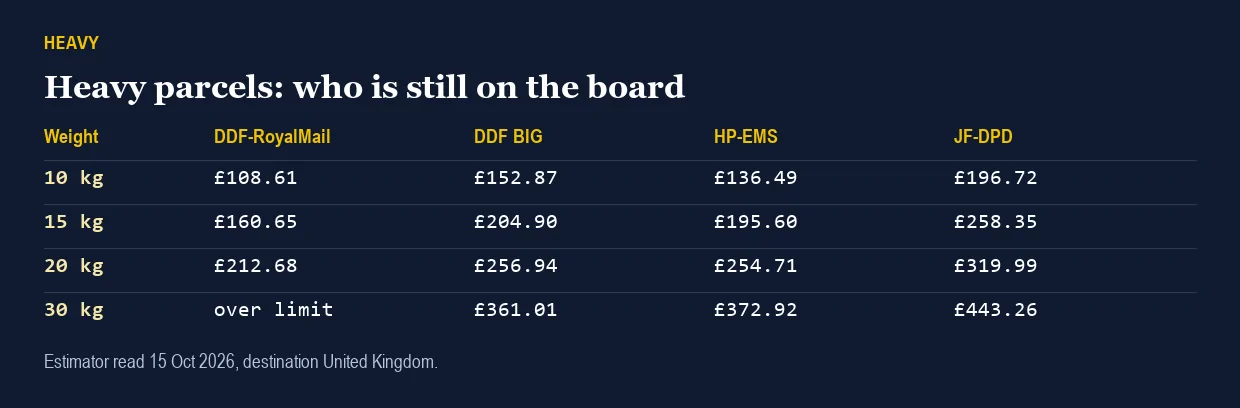
Up to 20 kg, DDF-RoyalMail stays cheaper than DDF BIG: at 10 kg £108.61 against £152.87, at 20 kg £212.68 against £256.94. The gap holds at about £44 all the way, so BIG only earns its place once a parcel is too heavy for the 20 kg lines. Past 20 kg DDF-RoyalMail drops off and the choice is BIG, HP-EMS or JF-DPD. At 30 kg we read £361.01 on BIG, £372.92 on HP-EMS and £443.26 on JF-DPD.
A heavy parcel is also one customs is more likely to look at. Oopbuy's own packaging page says parcels over 10 kg are more likely to be treated as commercial; see the VAT page before you build one.
Splitting one heavy parcel into two
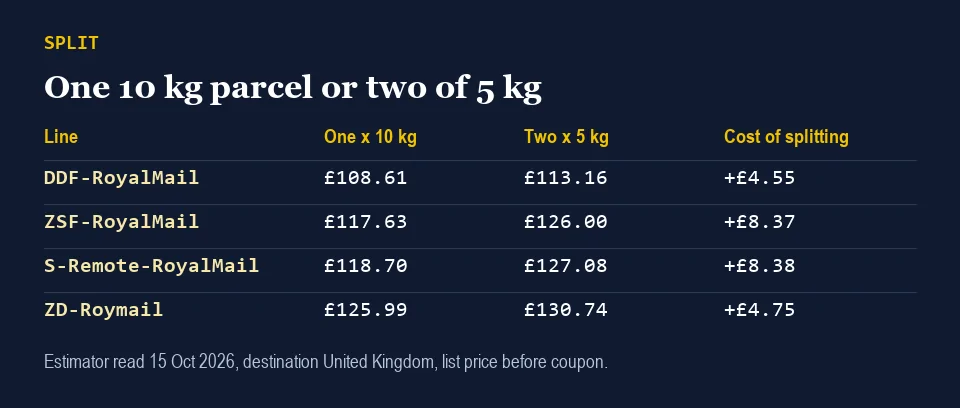
Splitting is the usual advice for a heavy haul, and Oopbuy's own tax page recommends it to spread customs risk. On the UK board it costs money rather than saving it. One 10 kg parcel on DDF-RoyalMail reads £108.61; two 5 kg parcels read £113.16 together. The same pattern holds on ZSF, S-Remote and ZD-Roymail, because each parcel pays its own first-weight step.
So split for a reason, not by habit. Good reasons: keeping each parcel at or under the £135 VAT line, keeping a battery item off an otherwise soft-goods box, or staying under the 10 kg mark the packaging page associates with commercial parcels. A few pounds is a fair price for any of those. It is a poor price for nothing.