
Oopbuy UK Arrival Planner for a parcel
Weight, postcode, contents and a dispatch day in; recorded UK lines to investigate, a dated price reading and an indicative arrival window out.
Plan a UK parcel
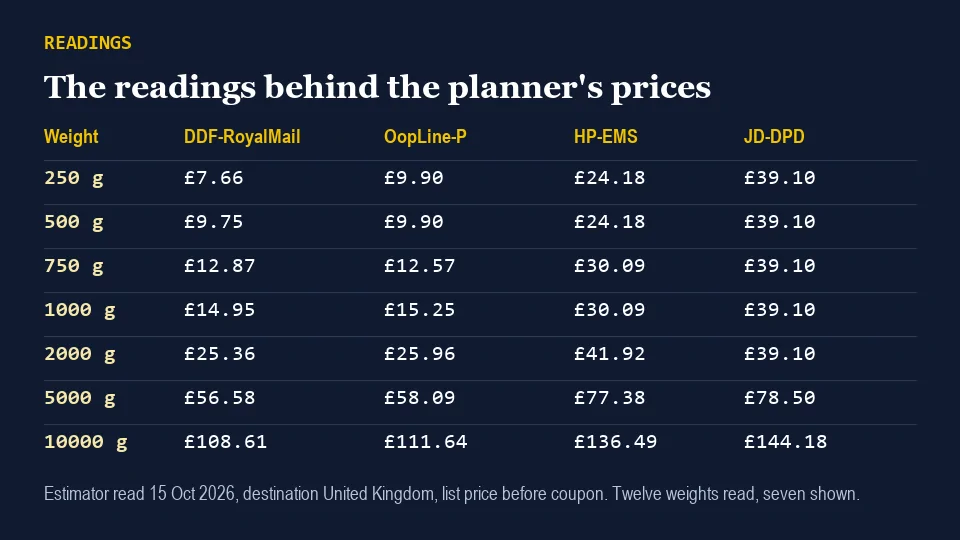
Results come from the 15 October 2026 estimator readings for the United Kingdom. Prices are the list price at the nearest weight we read at or above yours, before any coupon. Windows are the card's business-day range laid on the calendar. Shares are taken from each line's detail panel: of the parcels sent between 15 September and 15 October that were delivered, how many arrived inside each band of days.
Loading the 15 Oct 2026 readings.
How to use the Arrival Planner
Start with the packed weight. Item weights from listings undercount: the warehouse adds the box, padding and tape, and some lines also bill volume. If you already have the warehouse's packed weight from a parcel preview, use that.
Type the first half of your postcode. The planner only needs the area and district, for example IV27 or BT9, to decide whether the line texts treat you as remote.
Choose the most restricted thing in the box, not the most common. One pair of earbuds in a box of T-shirts makes it a battery parcel.
Set the dispatch day. The window is counted from the day the parcel leaves Xiamen, not from the day you ordered.
Reading the result
Each line that survives the filters shows three things. The price reading is the list price at the nearest weight we read at or above yours: at 1,200 g it shows the 1,500 g reading, which is a recorded weight step, not a guaranteed upper quote: packed volume and current charges may still increase the bill. The window is the earliest and latest calendar date the card's range points to. The shares say what fraction of last month's delivered parcels on that line arrived within 10, 15 and 20 days.
Lines that fall out are listed underneath with the reason: over the weight window, will not carry that item type, or refuses remote addresses. A line marked 'check' is one whose description is silent about remote addresses, or your postcode area is only partly remote.
What the planner leaves out
It does not price volume weight, because that needs your box size and the warehouse measures it after packing. Use the weight and size page to check a bulky box by hand.
It does not know about coupons, member discounts, live price changes after 15 Oct 2026, customs holds or a carrier's fee bill. And it does not choose for you: the cheapest line and the fastest line are both shown, and the trade-off is yours.
When you are ready to pay, run the same parcel through the official estimator once more.
Three worked examples
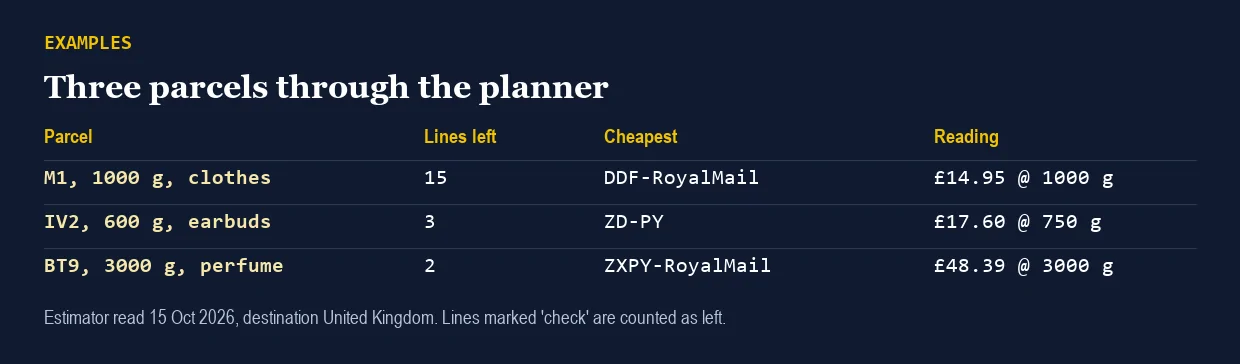
A 1 kg parcel of clothes to Manchester (M1) keeps all fifteen lines. The cheapest reading is DDF-RoyalMail at £14.95, and because DDF sits in the fast delivery profile it is also among the quickest. This is the easy case, and most UK parcels look like it.
A 600 g parcel with a pair of earbuds to Inverness (IV2) is a different problem. The battery removes nine lines, the remote postcode removes most of the rest, and three remain: ZD-PY, ZXPY-RoyalMail and JB-hermes, the last flagged because its description is silent about remote addresses. ZD-PY reads £17.60 at the 750 g step.
A 3 kg parcel with perfume to Belfast (BT9) leaves two: ZXPY-RoyalMail at £48.39 and JB-hermes, again flagged. Take the perfume out and the same parcel has three remote lines to choose from, all cheaper per kilo.
The pattern holds for most parcels: weight rarely decides the line on its own. Postcode and contents do.