
Oopbuy delivery time to the UK: five clocks compared
Two help pages, the route card, the card's own description and the measured delivery shares. Which to plan with, and why.
Clock one: the help page that says five to twelve days
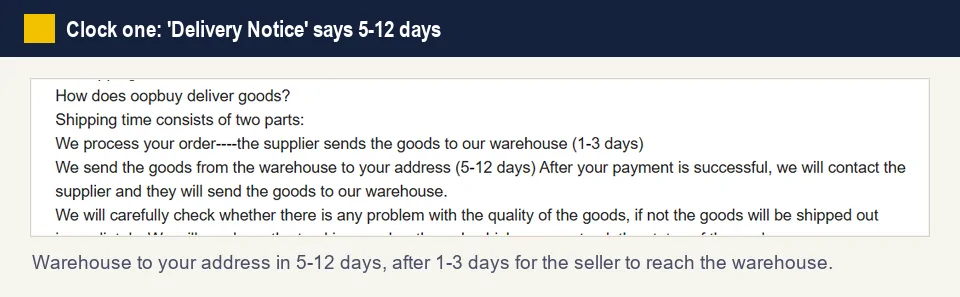
Oopbuy's 'Delivery Notice' help page splits shipping time into two parts: 1-3 days for the supplier to reach the warehouse, then 5-12 days from the warehouse to your address.
It names no country and no line. Of the fifteen UK cards, none promises a range that ends at 12 business days except OopLine-P's 8-12, and none starts at 5. Read it as a statement about some destination on some line, written before the current UK board existed.
Clock two: the help page that says fifteen to thirty days
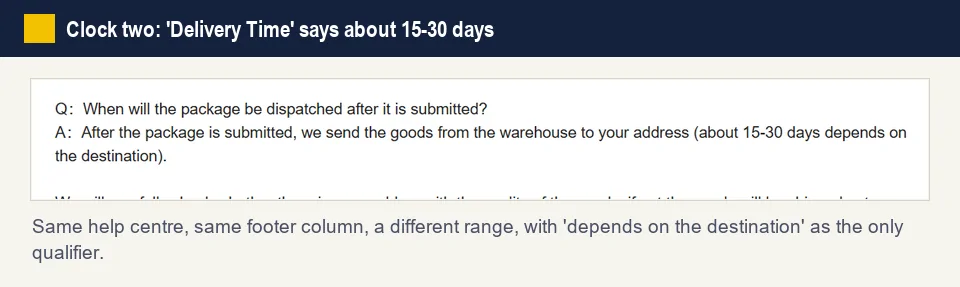
Sitting one link above it in the footer, the 'Delivery Time' page answers the question 'When will the package be dispatched after it is submitted?' with 'about 15-30 days depends on the destination'.
That range is calendar days, not business days, and it is closer to the slow end of the UK board. Like clock one it names no line. The two pages are three columns apart in the same help centre and do not refer to each other.
Clock three: what each UK card promises
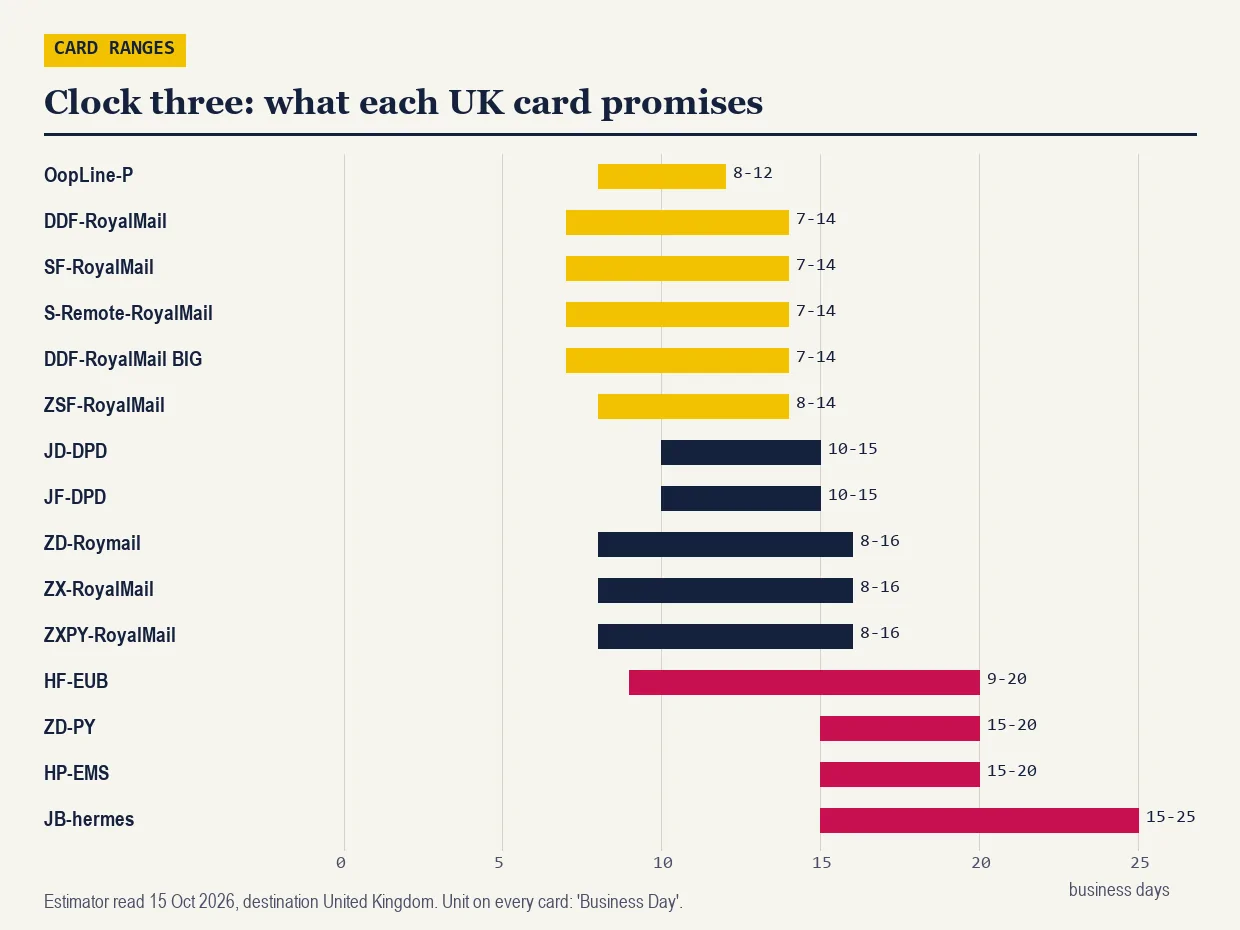
Each route card prints a 'Shipping Time' in business days. On the UK board those ranges fall into three bands. Six lines promise 7-14 or tighter. Five promise up to 15 or 16. Four promise up to 20 or 25: HF-EUB, ZD-PY, HP-EMS and JB-hermes.
ZD-PY is the odd one. Its card says 15-20 business days, the slowest lower bound on the board along with HP-EMS and JB-hermes, yet its measured profile matches the middle band: about 86% of recent parcels arrived within 15 days. For a remote postcode that is good news, but it shows how loosely the card range tracks the measured result.
Clock four: descriptions that disagree with their own card
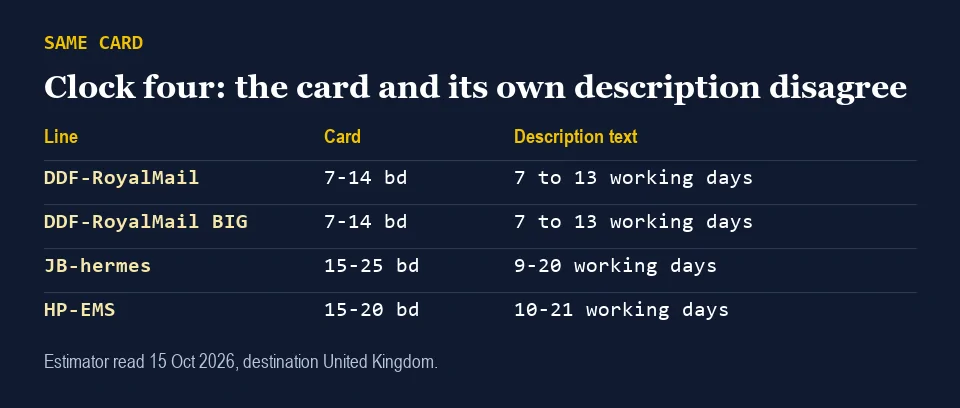
Four UK cards print a second time range inside their description. DDF-RoyalMail and DDF BIG say 'usually 7 to 13 working days' under a card that says 7-14. JB-hermes says 'usually 9-20 working days' under 15-25. HP-EMS says 'Normal time limit: 10-21 working days' under 15-20.
These are small gaps for the DDF pair and large ones for the other two. When the card and its description disagree, the card is the figure the late coupon is measured against, so that is the one to quote if a parcel runs late.
Clock five: what actually arrived
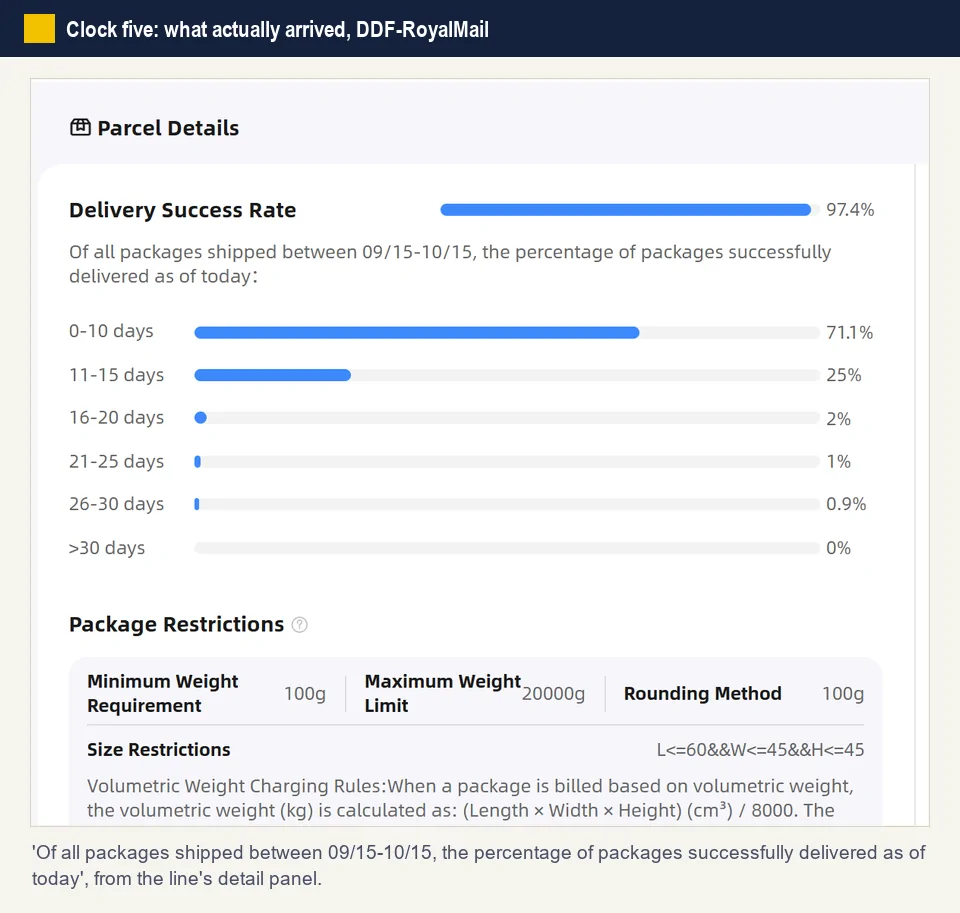
Click 'View Details' on any card and the success rate opens into a breakdown: of all packages shipped between 15 September and 15 October, the share delivered in 0-10 days, 11-15, 16-20, 21-25, 26-30 and over 30, as of the day you look.
For DDF-RoyalMail on 15 October 2026 that was 71.1%, 25%, 2%, 1%, 0.9% and 0%. The bands add up to 100%, so they describe the parcels that were delivered; the 97.4% headline above them is the success rate across everything sent. Read together: almost every parcel arrived, and about 96% of those that did took 15 days or fewer.
Two cautions. The bands are days, not business days. And the window is rolling, so the same click next month describes different parcels.
Three profiles that repeat across the board
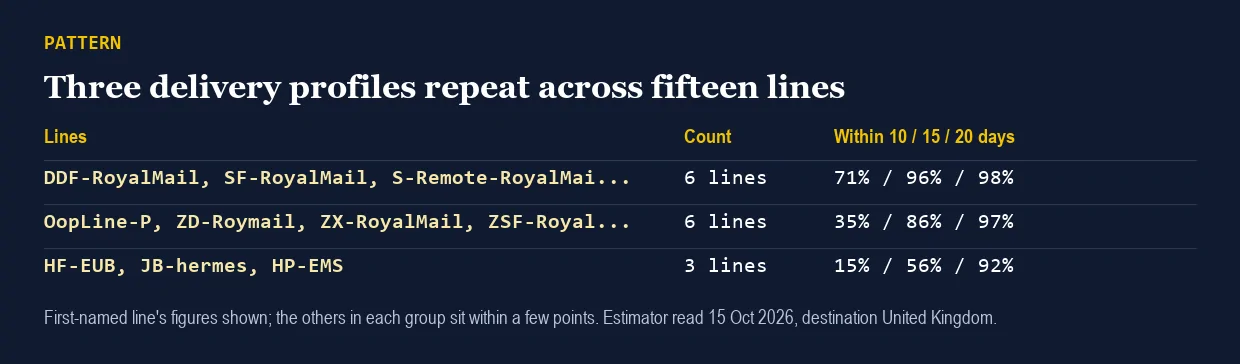
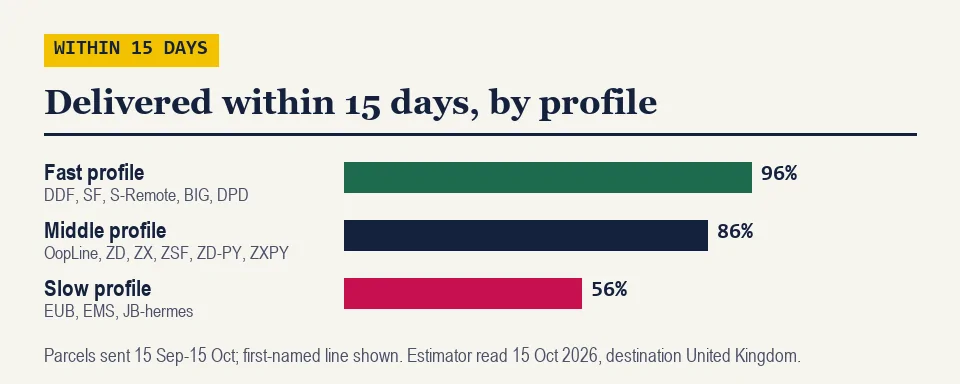
Line the fifteen breakdowns up and they collapse into three shapes that repeat almost to the decimal. A fast profile of about 71% within 10 days covers DDF-RoyalMail, SF, S-Remote, DDF BIG and both DPD lines. A middle profile of about 35% within 10 and 86% within 15 covers OopLine, ZD-Roymail, ZX, ZSF, ZD-PY and ZXPY. A slow profile of about 15% within 10 and 56% within 15 covers EUB, EMS and JB-hermes.
Six different lines landing on 70.2 to 71.1% in the same band suggests the figures are pooled per group of lines, not measured line by line. We cannot confirm that from the outside, so treat each profile as a description of the group the line belongs to.
Which number to plan with
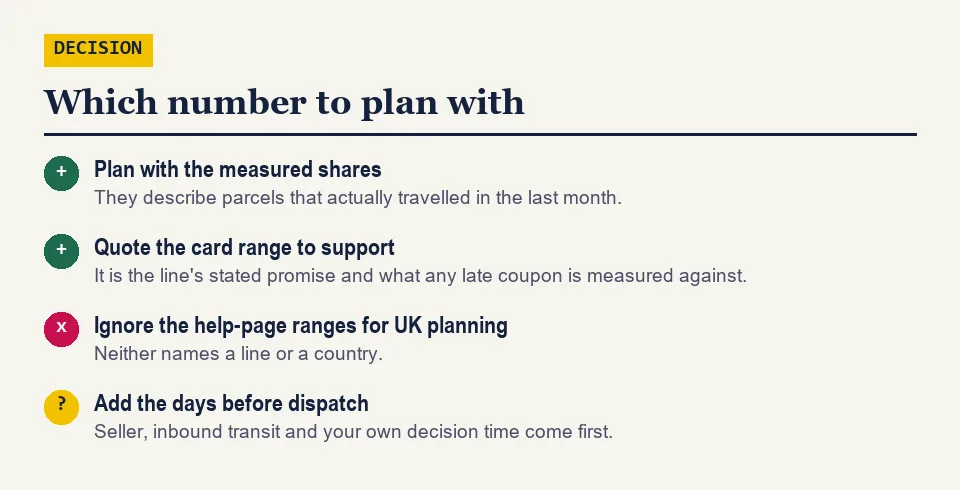
Plan with clock five. It is the only figure that describes parcels that actually went to the UK in the last month, and the profile tells you more than the range: a fast-profile line gets most parcels home inside two weeks, a slow-profile line about half.
Quote clock three to support. It is the line's stated promise and the basis for the late coupon. Use clock four only as a hint that a card may be optimistic. Leave clocks one and two out of UK planning; neither names a line or a destination.
Then add the days before dispatch. None of the five clocks starts until the parcel leaves Xiamen.
Business days, calendar days and the late coupon
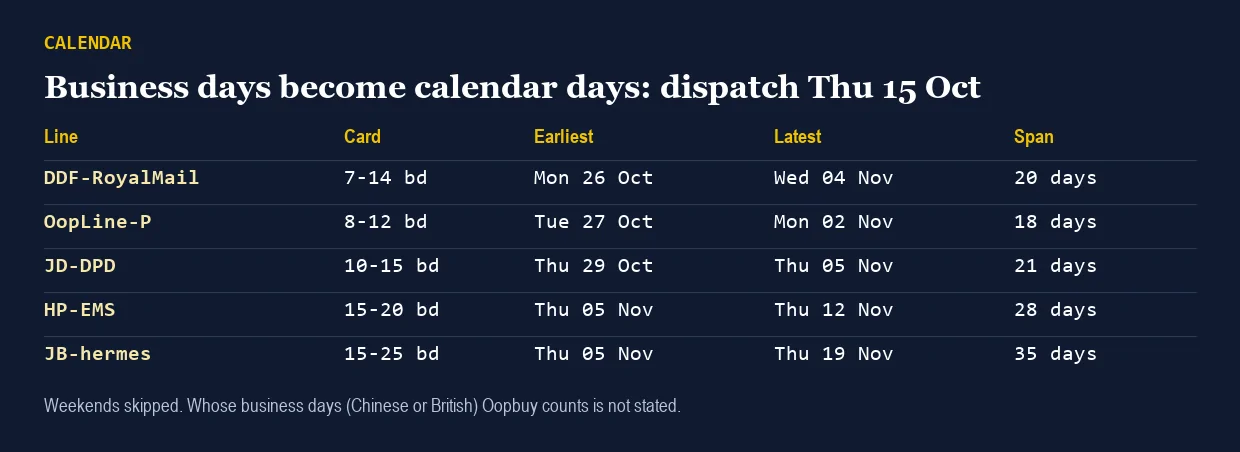
A business-day range stretches once weekends are put back. DDF-RoyalMail's 7-14 business days from a Thursday dispatch runs to 20 calendar days; JB-hermes's 15-25 runs to five weeks. Oopbuy does not say whose business days it counts, Chinese or British, so the planner skips weekends and England and Wales bank holidays and stops there.
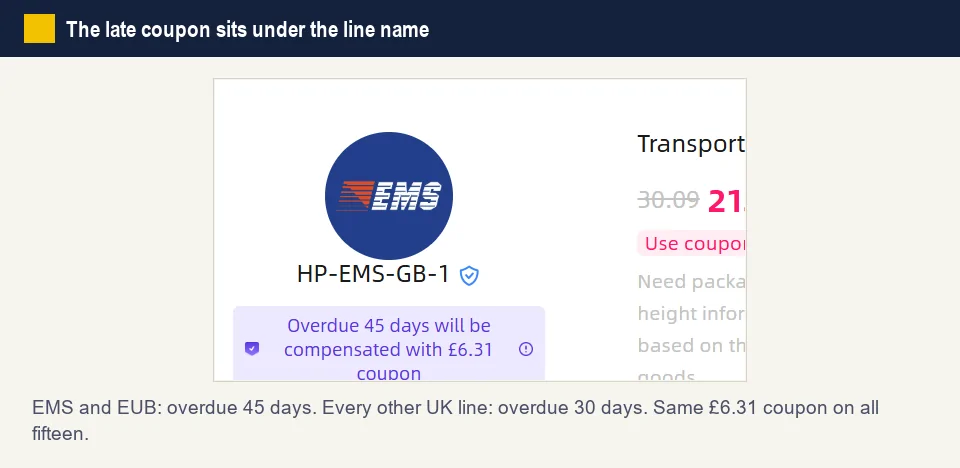
Every UK card shows the same compensation: a £6.31 coupon if the parcel is overdue by 30 days, or 45 days on EUB and EMS. It is the same coupon on a £10 parcel and an £80 one, and the official 'Global Logistic Guarantee' page adds nothing beyond a line saying further guarantees will follow.
Delivery time questions
How long does Oopbuy take to deliver to the UK
Why does the help centre say 5-12 days
Is the card range in working days
- Arrival PlannerTurn a line and a date into a window.
- Before the line startsThe days no card counts.